
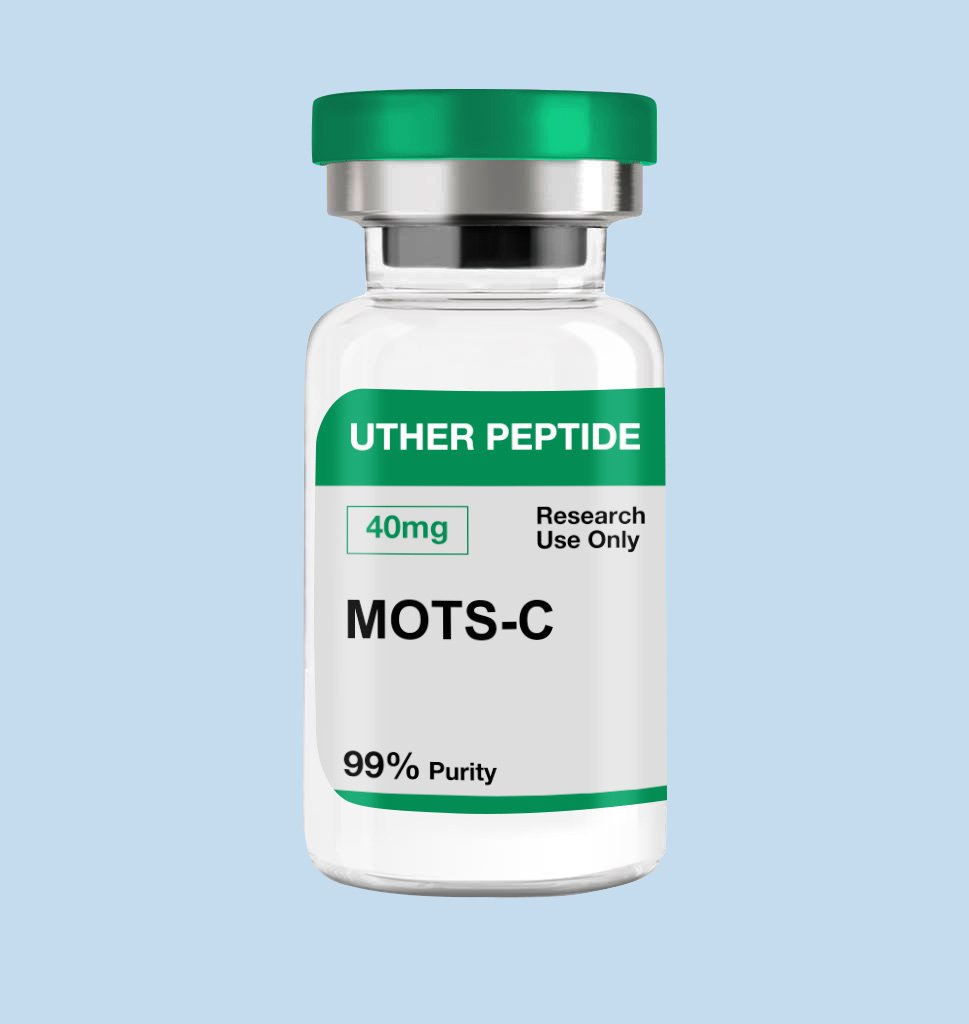

MOTS-C 40mg (10 Vials / Kit)
$210.00
MOTS-c, a mitochondrial-derived peptide (10mg, 20mg, 40mg), is studied for metabolic regulation, insulin sensitivity, and physical performance. Research highlights its role in enhancing mitochondrial efficiency, glucose uptake, cellular communication, and inflammation modulation, especially in aging and metabolic di…
MOTS-c, a mitochondrial-derived peptide (10mg, 20mg, 40mg), is studied for metabolic regulation, insulin sensitivity, and physical performance. Research highlights its role in enhancing mitochondrial efficiency, glucose uptake, cellular communication, and inflammation modulation, especially in aging and metabolic disorder models.
- Molecular Formula: C₁₀₁H₁₅₂N₂₈O₂₂S₂
- Molecular Weight: 2174.6 g/mol
- Purity: 99%
- Sequence: Met-Arg-Trp-Gln-Glu-Met-Gly-Tyr-Ile-Phe-Tyr-Pro
Latest Testing:
Description
MOTS-c is one of those small bioactive peptides that has been catching researchers’ eyes. It was first identified a little over ten years ago. Unlike many synthetic lab-made molecules, MOTS-c is actually encoded in the mitochondrial genome.
A surprising signaling role
That detail gives it a strange and almost unexpected role in biology. For decades, mitochondria were treated as the cell’s “power plants,” nothing more than energy factories. MOTS-c challenged that view. It showed that mitochondria may also “talk back” to the nucleus and other parts of the cell through signaling peptides.
Why should we care?
Because MOTS-c might help explain how our cells cope with stress, how they age, and how they adapt when metabolism shifts. Some scientists see it as a missing piece connecting metabolism, disease, and longevity.
At the same time, it’s worth stepping back. The data are still early. Findings in mice or cultured cells don’t always carry over to humans. And in this field, hype tends to move faster than the science.
Structure and Biological Role
MOTS-c is a short peptide made up of just 16 amino acids, encoded by a small open reading frame within the mitochondrial 12S rRNA region. That detail is important: for decades, the mitochondrial genome was assumed to code only for components of oxidative phosphorylation, not signaling peptides. MOTS-c broke that assumption.
Functionally, it seems to act as a metabolic regulator. Research suggests MOTS-c helps cells adapt to nutrient stress, especially by tweaking glucose utilization. Unlike larger proteins that operate through direct enzymatic activity, MOTS-c behaves more like a messenger—triggering pathways that adjust how cells handle energy.
There’s also an interesting age-related angle. Circulating levels of MOTS-c decline as organisms get older, which hints at a role in the aging process. But here again, the causality isn’t settled. Does a drop in MOTS-c contribute to aging, or is it simply a downstream marker of cells that are already less efficient? That distinction matters, and it hasn’t been sorted out yet.
Mechanisms of Action
MOTS-c interacts with AMPK, one of the most studied metabolic switches in cells. AMPK activation generally promotes mitochondrial biogenesis, fatty acid oxidation, and glucose absorption—all of which support energy balance. MOTS-c appears to mirror some of these effects, urging cells into a more energy-efficient mode, particularly under stress.
In animal investigations, MOTS-c treatment was connected to enhanced exercise tolerance in skeletal muscle. That is consistent with the peptide’s apparent role in glucose metabolism—more efficient fuel handling may translate into improved performance. However, these are only preliminary observations. The translation to humans is not a given.
There’s also evidence that MOTS-c influences oxidative stress pathways. By modulating antioxidant responses, it may reduce the cellular “wear and tear” caused by free radicals. That sounds promising, but we should resist oversimplification. Oxidative stress is a double-edged sword: some level is necessary for signaling and adaptation, and too much suppression can be harmful. Whether MOTS-c strikes the right balance in different contexts is still an open question.
Potential Research Applications
The majority of the numerous potential uses for MOTS-c that the research community has proposed are still theoretical. Animal models demonstrate that MOTS-c therapy can increase insulin sensitivity and decrease blood glucose levels in metabolic diseases such as type 2 diabetes and obesity. Considering how common and expensive these illnesses are, this would be a significant advancement if verified in humans.
Another line of investigation looks at aging. Since MOTS-c levels decline with age, researchers have suggested supplementing it could mitigate age-related metabolic decline. There’s even been discussion about its potential as part of longevity interventions. Yet we’re still a long way from knowing whether MOTS-c can extend healthy lifespan, let alone total lifespan, in humans.
Interestingly, MOTS-c also appears relevant to physical performance. Some studies in mice reported that treated animals showed better endurance, sparking speculation about applications in sports science. That brings its own ethical questions. If MOTS-c supplements became widely available, would they fall under performance enhancement regulations, or could they be framed as legitimate therapies for age-related muscle decline? The distinction is blurry.
Current Research Findings and Limitations
The most reliable evidence so far comes from controlled animal experiments. For example, mice given MOTS-c showed improved glucose tolerance, greater insulin sensitivity, and enhanced exercise capacity. Human data, though, are sparse. A few small-scale studies suggest MOTS-c circulates in the blood and is responsive to exercise stress, but we don’t yet have large trials testing supplementation in people.
Limitations are worth underscoring. First, peptides often have poor stability in the bloodstream, which makes dosing and delivery tricky. MOTS-c might degrade quickly, requiring modifications or special formulations. Second, we don’t know much about long-term safety. Just because a peptide is naturally occurring doesn’t mean that adding more of it will always be safe. Hormones provide plenty of cautionary tales in that respect.
There’s also the question of biological context. A peptide that improves metabolic balance in one situation may not do so in another. For instance, in athletes who already have optimized metabolism, MOTS-c could act differently than in older adults with impaired glucose regulation. Until these nuances are clarified, it’s hard to generalize the findings.
Future Directions
MOTS-c has shifted how scientists think about the mitochondria. Once viewed mostly as cellular “power plants,” mitochondria are now recognized as active signaling hubs. Whether MOTS-c becomes a therapy or not, it has already expanded our understanding of how deeply connected energy regulation, aging, and disease really are.
Related products
FOX04 10mg (10 Vials / Kit)
HCG 2000IU GMP (10 Vials / Kit)
Retatrutide 50mg (10 Vials / Kit)
Semax 10mg (10 Vials / Kit)
TB-500 FRAG 10mg (10 Vials / Kit)
Tirzepatide 100mg (10 Vials / Kit)
Tirzepatide 15mg (10 Vials / Kit)