
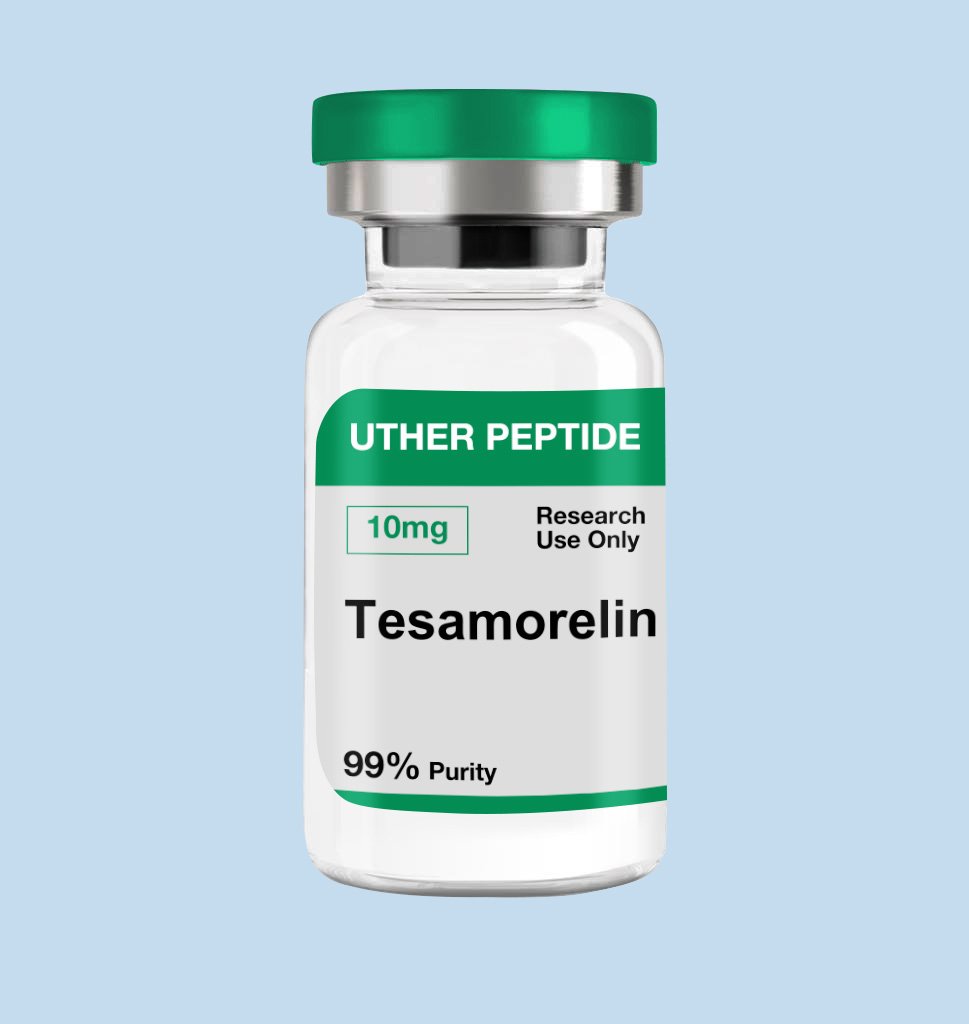
Tesamorelin 10mg (10 Vials / Kit)
$145.00
Tesamorelin is a synthetic peptide that stimulates growth hormone release. Used in metabolic research, it supports studies on visceral fat reduction, hormone regulation, and potential effects on aging, energy balance, and metabolic health in experimental models. Molecular Formula: C₂₂₁H₃₆₆N₇₂O₆₇S Molecular Weight: 5…
Tesamorelin is a synthetic peptide that stimulates growth hormone release. Used in metabolic research, it supports studies on visceral fat reduction, hormone regulation, and potential effects on aging, energy balance, and metabolic health in experimental models.
- Molecular Formula: C₂₂₁H₃₆₆N₇₂O₆₇S
- Molecular Weight: 5136 g/mol
- Purity: 99%
Latest Testing:
Description
Overview
Tesamorelin is a synthetic peptide that emulates the body’s endogenous growth hormone-releasing hormone (GHRH). By connecting to GHRH receptors in the anterior pituitary, it stimulates the gland to autonomously secrete increased levels of growth hormone (GH). The U.S. Food and Drug Administration (FDA) sanctioned it largely for HIV-associated lipodystrophy, a disorder characterized by atypical fat accumulation. Since that time, it has garnered increasing attention for its probable functions in metabolism and age-related hormonal decrease.
Instead of perceiving tesamorelin merely as another hormone therapy, it may be more accurately seen as a precisely calibrated signal enhancer—an agent that prompts the body to reestablish a more natural cadence of hormone secretion. This paper examines its chemistry, pharmacology, and clinical research, and contemplates the implications of its expanding application for metabolic health.
Chemical Structure and Pharmacology
Tesamorelin is a 44-amino acid peptide that is closely modeled on human GHRH but has been modified to function more effectively and last longer in the body [1]. By preventing enzymes from breaking it down excessively, these modifications result in a prolonged half-life and more stable activity in vivo. Upon injection beneath the skin, it binds to GHRH receptors on pituitary somatotroph cells, thereby initiating the release of GH. This, in turn, induces the liver to generate insulin-like growth factor 1 (IGF-1), which initiates a cascade that facilitates lipolysis, the process of breaking down fat [4].
The pharmacokinetic data indicates that tesamorelin is absorbed relatively rapidly and maintains blood levels at a level that is sufficient to increase GH and IGF-1 in a predictable, quantifiable manner [3]. Its receptor specificity is particularly alluring, as it appears to act primarily in the intended location, thereby avoiding some of the off-target issues observed with direct GH therapy.
Tesamorelin in Research
Binding and Mechanism
What makes tesamorelin interesting pharmacologically is how closely it imitates natural hormone signaling. By attaching to GHRH receptors on somatotrophs, it triggers GH secretion in pulses—much like what the body would do on its own. In contrast, direct GH injections can overwhelm this system and sometimes push hormone levels too high [4]. Tesamorelin’s more physiologic approach may help preserve the feedback balance that keeps hormone levels steady.
HIV-Associated Lipodystrophy
For individuals with HIV, lipodystrophy transcends mere cosmetic concerns; it is frequently associated with metabolic dysfunction and psychological distress. In several randomized controlled trials, patients administered tesamorelin reduced their visceral fat by around 15% relative to placebo after 26 weeks [1]. The benefit persisted with ongoing use, and notably, there were no significant alterations in limb fat or glucose metabolism. The equilibrium between efficacy and metabolic stability distinguishes tesamorelin.
Broader Metabolic Outcomes
Interestingly, the benefits may go beyond fat reduction. Several studies report improvements in triglyceride and cholesterol levels, along with reductions in cardiovascular risk markers [4]. Some participants also noted better physical comfort and self-image [3]. These quality-of-life outcomes are easy to overlook in data tables, but they matter—especially in long-term management of chronic conditions.
Expanding Horizons: Age and GH Deficiency
Researchers have begun to inquire whether tesamorelin may assist elderly persons experiencing a natural decline in GH levels. Preliminary results indicate that it may augment endogenous GH secretion and slightly enhance body composition in this population. The evidence base remains weak, and long-term safety data are scarce [4]. Should further research validate these effects, tesamorelin may emerge as a safer, more physiological substitute for conventional GH therapy in age-related metabolic deterioration.
Final Thoughts
Tesamorelin occupies a unique intersection between conventional endocrinology and contemporary peptide science. It does not compel the body to perform unnatural actions; rather, it encourages the restoration of equilibrium. Its sanctioned application for HIV-associated lipodystrophy has already resulted in a significant improvement in patient health and well-being. However, as research progresses, it is becoming evident that tesamorelin’s potential encompasses multiple indications. It may eventually be included into comprehensive metabolic care, particularly for individuals requiring a more benign approach to hormone regulation without the adverse effects associated with synthetic growth hormone.
References
- Falutz, J., Allas, S., Blot, K., Potvin, D., Kotler, D., Somero, M., … & Mamputu, J. C. (2010). Metabolic effects of a growth hormone–releasing factor in patients with HIV. The New England Journal of Medicine, 363(8), 733–742.
- Koutkia, P., Canavan, B., Breu, J., Torriani, M., Grinspoon, S. (2004). Metabolic effects of recombinant human growth hormone in patients with HIV lipodystrophy: A randomized, controlled trial. Annals of Internal Medicine, 140(12), 963–972.
- Stanley, T. L., Falutz, J., Marsolais, C., Potvin, D., Mamputu, J. C., & Grinspoon, S. K. (2011). Effects of tesamorelin on inflammatory markers in HIV-infected patients with abdominal fat accumulation. The Journal of Clinical Endocrinology & Metabolism, 96(9), 2738–2745.
Related products
BPC-157 20mg (10 Vials / Kit)
HCG 5000 GMP (10 Vials / Kit)
LL-37 5mg (10 Vials / Kit)
PNC-27 30mg (10 Vials / Kit)
TB-500 10mg (10 Vials / Kit)
TB-500 FRAG 10mg (10 Vials / Kit)
Tirzepatide 15mg (10 Vials / Kit)