
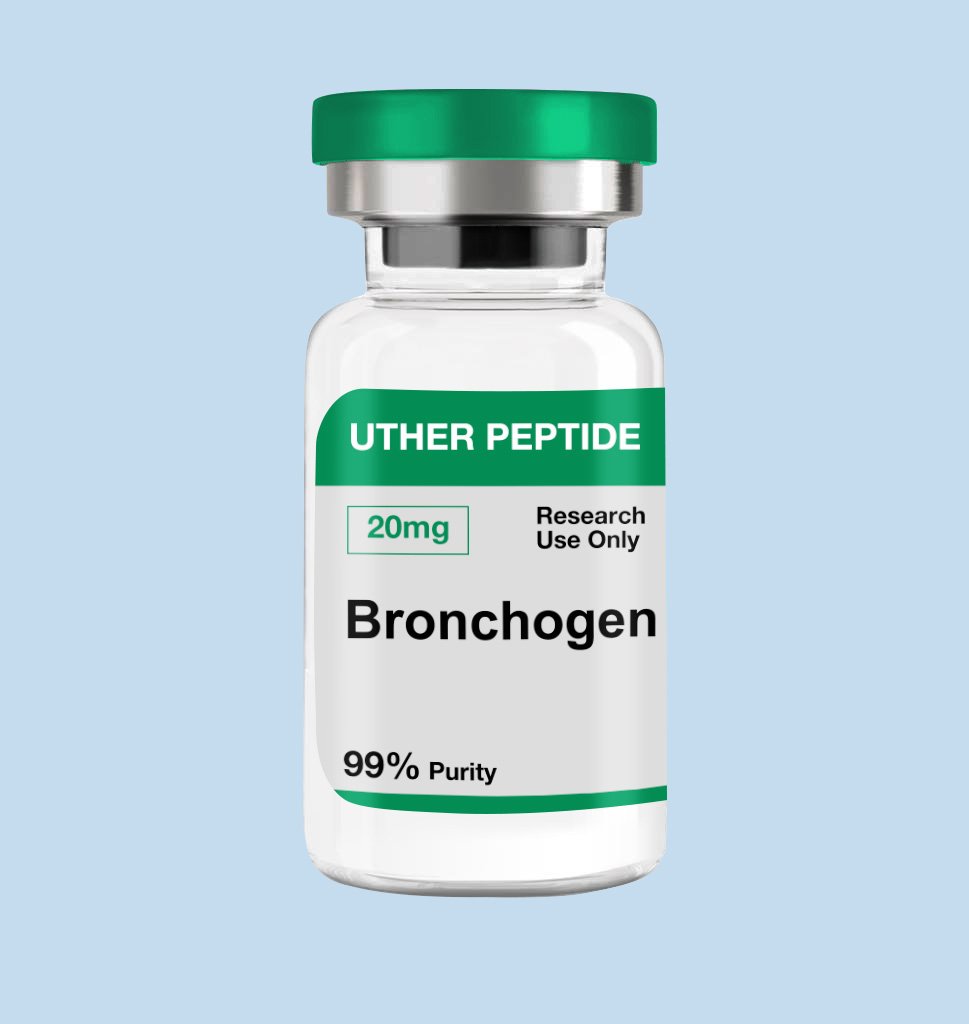

Bronchogen 20mg (10 Vials / Kit)
$150.00
Bronchogen is a peptide used in respiratory research to support bronchial mucosa repair. Studies suggest it may reduce inflammation, promote epithelial regeneration, normalize mucus production, and aid lung tissue recovery, providing insights into chronic pulmonary disease models. Molecular Formula: C₁₈H₃₀N₄O₉ Molec…
Bronchogen is a peptide used in respiratory research to support bronchial mucosa repair. Studies suggest it may reduce inflammation, promote epithelial regeneration, normalize mucus production, and aid lung tissue recovery, providing insights into chronic pulmonary disease models.
- Molecular Formula: C₁₈H₃₀N₄O₉
- Molecular Weight: 446.45 g/mol
- Purity: ≥99%
- Sequence: Ala-Glu-Asp-Leu
Latest Testing:
Description
Bronchogen peptide, also known as AEDL, is a small bioactive Khavinson peptide with potential benefits for lung health. It may act as a bioregulator, crossing cell and nuclear membranes to influence DNA and regulate genes like NKX2-1, SCGB1A1, SCGB3A2, FOXA1, and FOXA2. Early studies suggest it can support tissue repair, modulate immune responses, and reduce inflammation, as seen in murine models of bleomycin-induced fibrosis. Animal and preclinical data hint at relevance for asthma, COPD, and lung injury, while clinical trials continue to explore its safety, dosage, and therapeutic potential.
Bronchogen and Cell Renewal
Maintaining cell renewal in the bronchial epithelium is key for respiratory health, both for barrier function and for responding to injury. This renewal is regulated by various signaling molecules, including peptides. Interestingly, Yang et al. (2014) describe in cancer research how invasive cell populations shape their microenvironments to improve survival. Although their work focuses on tumors, the concept—sometimes called “ecosystem engineering”—might apply to normal bronchial tissue as well. Bronchogen peptide, if it truly enhances epithelial renewal, could act as a kind of internal engineer, subtly adjusting the local tissue environment to support regeneration and balance [3].
In Vitro Studies
Lab studies on peptides like Bronchogen usually involve bronchial epithelial cells to see how they influence proliferation, differentiation, or secretion. Sometimes immune cells are added to the mix, since epithelial and immune responses are tightly linked in the airway.
Regulating cell proliferation and cytokine production is a hallmark of peptide activity. In cancer, for example, factors secreted by tumor cells—conceptually similar to Bronchogen—can modify nearby cells, increase heterogeneity, and improve survival chances [3]. Translating this to the bronchial context, Bronchogen may similarly affect epithelial growth and cytokine signaling, which could help repair tissue—or, if misregulated, contribute to unwanted remodeling.
Mucus production is another important aspect of bronchial function. Peptides that influence cytokine networks may indirectly alter mucus secretion, for instance by affecting goblet cell activity. This effect mirrors the kind of niche engineering seen in cancer studies [3], though in a potentially beneficial way.
Bronchogen and DNA
Bioactive peptides can also impact DNA integrity, particularly when they influence proliferation and differentiation. Cancer research shows that environmental cues—often mediated by peptides—can cause genetic instability or favor certain cell clones [3]. For Bronchogen, the impact on DNA might be a double-edged sword: it could support healthy tissue renewal, but repeated stimulation of growth pathways might theoretically raise mutation risks. There isn’t direct evidence yet, but the analogy with niche construction in cancer offers a useful caution.
Therapeutic Applications
Peptide-based therapies are appealing because they can target physiological pathways with a fair degree of specificity. Using Bronchogen in regenerative medicine would require careful testing for both safety and efficacy. Some researchers suggest Bayesian data assimilation could help in clinical trials [2], combining patient data with prior knowledge to make probabilistic predictions about outcomes and side effects.
It’s also worth noting that, as seen with areas like medical cannabis, public information and market trends can sometimes move faster than research, creating unrealistic expectations or underreported risks [1]. Any therapeutic development with Bronchogen should prioritize clear communication and evidence-based guidance.
Conclusion
Although still early in its research journey, Bronchogen peptide may offer a way to influence bronchial cell renewal and tissue balance. Insights from cancer ecology hint at the subtle, yet powerful effects peptides can have on local cell environments, from proliferation to cytokine signaling and possibly DNA integrity. Turning this into a therapy will require rigorous lab work, careful data analysis, and transparent risk assessment. Ultimately, realizing Bronchogen’s potential will demand collaboration across cell biology, clinical pharmacology, and patient communication.
References
- Macedo, A. C., de Faria, A. O. V., Bizzi, I., Moreira, F. A., Colasanti, A., & Ghezzi, P. (2020). Online information on medical cannabis may rise unrealistic expectations and downplay potential side effects. http://arxiv.org/pdf/2004.02330v1
- Maier, C., Hartung, N., de Wiljes, J., Kloft, C., & Huisinga, W. (2019). Bayesian data assimilation to support informed decision-making in individualised chemotherapy. http://arxiv.org/pdf/1909.09451v1
- Yang, K. R., Mooney, S., Zarif, J. C., Coffey, D. S., Taichman, R. S., & Pienta, K. J. (2014). Niche inheritance: a cooperative pathway to enhance cancer cell fitness though ecosystem engineering. http://arxiv.org/pdf/1403.7413v1
Related products
Cortagen 20mg (10 Vials / Kit)
Crystagen 20mg (10 Vials / Kit)
Epitalon 10mg (10 Vials / Kit)
Kisspeptin-10 10mg (10 Vials / Kit)
Testagen 20mg (10 Vials / Kit)
Thymulin 20mg (10 Vials / Kit)
Vesilute 20mg (10 Vials / Kit)