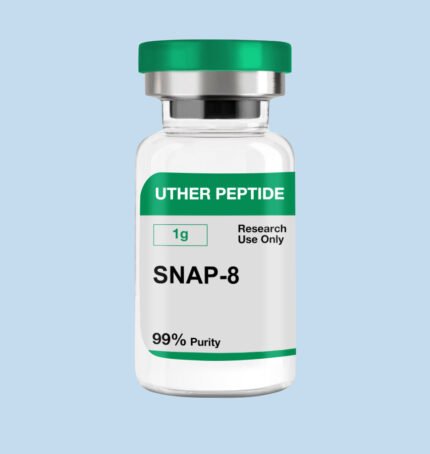

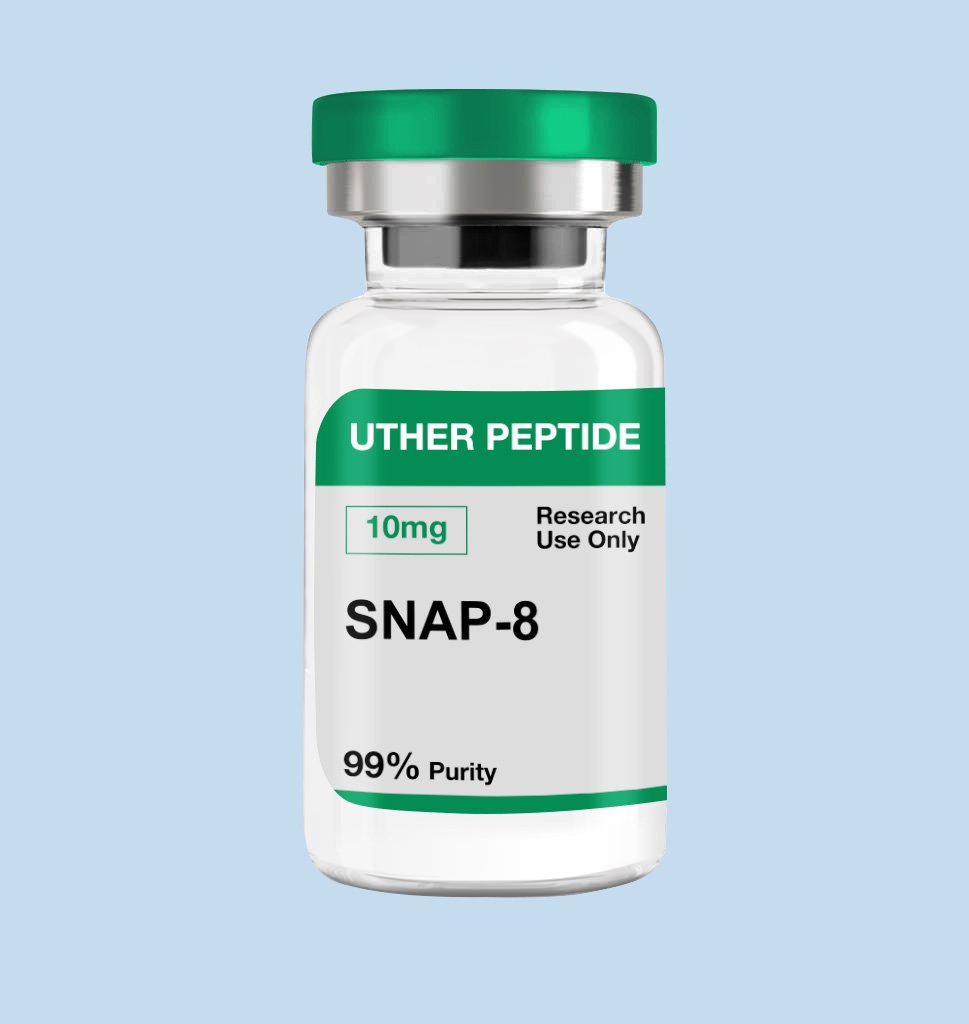
Snap-8 10mg (10 Vials / Kit)
$40.00
Snap-8, an acetylated octapeptide, is studied for its ability to inhibit neurotransmitter release, promoting muscle relaxation. Used in cosmetic research, it helps explore dynamic wrinkle formation and supports anti-aging and skin-rejuvenation studies. Molecular Formula: C₄₁H₇₀N₁₆O₁₆S Molecular Weight: 1075.16 g/mol…
Snap-8, an acetylated octapeptide, is studied for its ability to inhibit neurotransmitter release, promoting muscle relaxation. Used in cosmetic research, it helps explore dynamic wrinkle formation and supports anti-aging and skin-rejuvenation studies.
- Molecular Formula: C₄₁H₇₀N₁₆O₁₆S
- Molecular Weight: 1075.16 g/mol
- Purity: 99%
Latest Testing:
Description
Peptides have become essential components in cosmetic dermatology, especially for their ability to influence skin physiology and improve aesthetic results. Of these, Snap-8 peptide has attracted a lot of interest because of its alleged ability to improve skin texture and minimize expression lines. In addition to giving a general review of Snap-8 peptide, this essay clarifies its composition and structure and critically analyzes its potential uses in dermatology and cosmetics. Where appropriate, parallels are drawn to current understandings in the broader realm of structure–function relationships within biological and material sciences, as exemplified in recent research on structure and composition in biological and physical systems [2].
Overview of Snap-8 Peptide
A synthetic peptide called Snap-8 is intended to reduce the visibility of wrinkles by preventing the development of expression lines, especially those brought on by frequent facial movements. Snap-8, an octapeptide (acetyl glutamyl hexapeptide-1), was created as an extension of the previous Argireline (acetyl hexapeptide-3). Its primary use is as a topical ingredient in anti-aging skin care products. According to one theory, the peptide reduces muscle contraction at the neuromuscular junction by acting as a competitive inhibitor of the SNARE complex, a protein assembly involved in neurotransmitter release. Recent developments in biological imaging have shown that altering structural and compositional characteristics at the cellular level can have significant physiological impacts [2], which is comparable to this mode of action.
Structure and Composition
Snap-8’s effectiveness is closely related to its molecular makeup and structure. Eight amino acids make up Snap-8, an octapeptide, in the following particular order: Ac-Glu-Glu-Met-Gln-Arg-Arg-Ala-Asp-NH₂. This peptide’s initial amino acid sequence and the alterations at its N- and C-termini—acetylation and amidation, respectively—determine its structural integrity and bioactivity. By improving its stability and skin penetration, these changes guarantee that the peptide will continue to be active when applied topically.
Snap-8’s structure–function paradigm is similar to that of other biomolecular and material systems, where even little compositional or sequence changes can result in significant alterations to biological activity and physical characteristics. For instance, when studying zinc oxide (ZnO) thin films, the macroscopic electrical and optical behavior of the material is determined by composition and deposition parameters, which are strongly linked to micro-properties like grain size and stress [1]. Similar to this, Snap-8’s interaction with the SNARE complex depends on the exact arrangement of its amino acids and terminal modifications, which determines how well it works in cosmetic applications.
Cosmetic and Dermatological Benefits
The capacity of Snap-8 peptide to lessen the severity and appearance of facial wrinkles, especially those brought on by repetitive muscle contractions, is its main cosmetic advantage. Snap-8 is believed to replicate the function of botulinum toxin by competitively blocking the SNARE complex and modifying neurotransmitter release, but in a far less invasive way. In vitro tests and clinical research have shown that topical preparations containing Snap-8 can improve skin smoothness and reduce wrinkle depth in a quantifiable way.
It is potentially possible to connect the effects of Snap-8 on skin morphology and composition to more extensive scientific studies of biological systems’ structure and composition. For example, sophisticated imaging methods like extreme ultraviolet (EUV) ptychography have demonstrated that even minute changes in the content and shape of cells can have a significant impact on physiological function [2]. In a similar manner, topical Snap-8 administration causes micro-level alterations at the skin’s neuromuscular interface, which results in noticeable macro-level enhancements in dermal appearance.
It is important to remember that, similar to other peptide-based cosmeceuticals, Snap-8’s efficacy depends on a number of factors, including its delivery mechanism, concentration, and the inclusion of complementing compounds in the formulation. This is consistent with the results in materials science, where extrinsic deposition parameters and intrinsic compositional elements both affect the properties of ZnO thin films, for instance [1].
Conclusion
Using certain structural and compositional properties to produce desired clinical results, Snap-8 peptide is an advanced application of peptide chemistry in cosmetic dermatology. Its capacity to alter neuromuscular signaling, which is closely related to its molecular makeup, is the basis for its process of lowering expression lines. It is evident that the connection between structure, composition, and function is a common topic across disciplines when comparing recent studies in the domains of materials science and biological imaging. Future studies should focus on elucidating Snap-8’s long-term safety and effectiveness as well as investigating synergistic formulations that optimize its dermatological advantages.
References
-
David, T., Goldsmith, S., & Boxman, R. L. (2005). Dependence of zinc oxide thin films properties on filtered vacuum arc deposition parameters. arXiv preprint.
http://arxiv.org/pdf/cond-mat/0501374v1 -
Liu, C., Licht, L., Wichmann, C., Eschen, W., Chew, S. H., Hildebrandt, F., Penagos Molina, D. S., Eggeling, C., Limpert, J., & Rothhardt, J. (2024). Exploring physiological structure and composition in bacteria with high-resolution quantitative EUV ptychography. arXiv preprint.
http://arxiv.org/pdf/2503.06174v1
Related products
AHK-CU Raws 10g
Cerebrolysin 30mg (10 Vials / Kit)
GHK-CU 100mg (10 Vials / Kit)
GHK-CU 50mg (10 Vials / Kit)
GHK-CU Raws 10g (10 Vials / Kit)
GLOW Blend 70mg (10 Vials / Kit)